Test the economics before committing to the build.
I developed organism strategy, a conceptual bioprocess and technical-economic analysis for a space-biomanufacturing study. The practical skill is comparing technical options against the resource that actually limits the project.
Conceptual design and analysis; not deployed hardware.
Every figure on this page comes from the published analysis. Nothing was estimated to fill the page.
The currency was mass, not money
A techno-economic analysis almost always answers one question. What does it cost to make a kilogram of product, capital first and then operating cost, measured at the plant gate in dollars. The framing is so standard it reads like part of the physics.
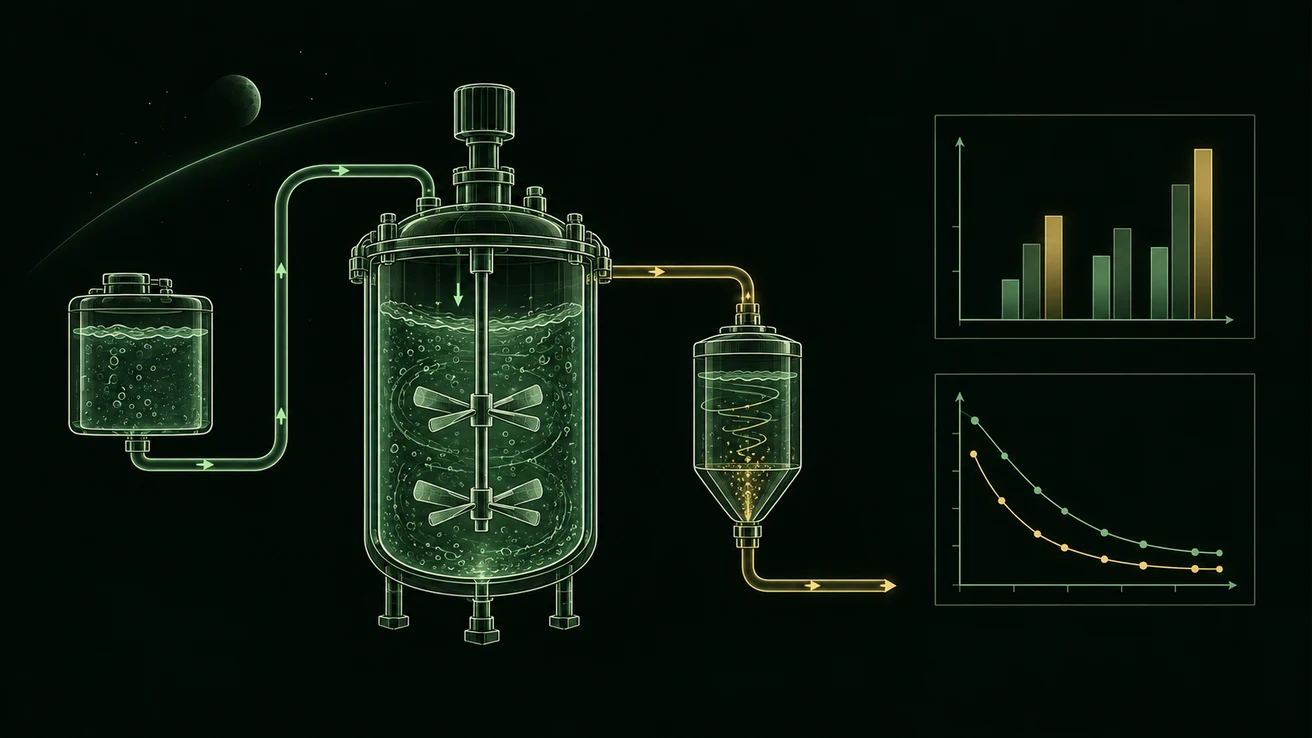
For this study it was the wrong question. The work was a conceptual design and techno-economic analysis of making lactic acid by fermentation aboard a crewed space mission, carried out under the DARPA BSURE program. The customer was NASA, and NASA does not price a process in dollars per kilogram of product. It prices it in kilograms lifted to orbit. Launch mass is what is scarce, so the objective changed: minimize the mass the mission has to carry, not the money the plant spends.
Change the currency and the cost of every input changes with it.
What that does to the cost of an input
Water shows it most clearly. On Earth water is cheap to buy and expensive to treat and discard, so a terrestrial model carries a small supply cost and a real disposal cost. On a crewed mission the accounting inverts. Water is heavy to launch, but a closed life-support loop already recycles it, and that same water can take up waste streams the process would otherwise have to handle on its own. Balanced across the whole mission instead of the plant gate, water's marginal cost falls close to zero.
That was the part worth the work. Not the destination, the inversion. Swap dollars for mass and the plant gate for the whole mission, and decisions that looked settled come apart and resettle somewhere else.
What the model produced
A 10 liter Escherichia coli bioreactor makes on the order of 258 kg of lactic acid a year in orbit. Run the same analysis for a Saccharomyces cerevisiae system and the yeast platform lands 37% lower on total system mass than the E. coli baseline. On a dollar objective the two organisms might rank one way. On a mass objective the yeast wins, and the reason sits in the mass balance where you can read it, not inside a cost spreadsheet.
What this is, and what it is not
This was a conceptual design and a techno-economic analysis. A model built from first principles with every assumption named, presented at FOCAPD 2024. It was not flight hardware. There was no flight test, no microgravity run, no mission profile, and no cost-per-kilogram number that would survive a real launch manifest. The value is in the method and how it reorders the tradeoffs, not in any claim that lactic acid has been fermented in space.
The work
Presented at FOCAPD 2024 (Foundations of Computer-Aided Process Design) and posted as a preprint. Four co-authors (Cansino-Loeza, McIntosh, Ternus, Zavala); full citation at the link below. I led the techno-economic analysis and the conceptual process design.
Space Biomanufacturing of Lactic Acid: Conceptual Design and Techno-Economic Analysis